Made From Freshly Squeezed Mummy
Alternative medicine is nothing new, but while things like crystals may have always been seen as a more hippy take on healthcare, at least they were effectively harmless. The same can't be said for injecting horse paste directly into your veins.
I grew up in the 90s and early 2000s, when vaccinating your children was just simply a prerequisite to their acceptance into society, and to go against that grain meant social ostracization, as it should. Nowadays, the country is awash in formerly nearly eradicated illnesses like measles, while middle-aged moms who have kids named Kaiden try and sell us on this idea of "alternative medicine", typically via MLM scams found on Facebook groups. But the thing is...as vitriolic towards their unfounded, dangerous beliefs as I may sound, they're not doing anything new. As it turns out, we've been doing this forever.
The issue is the time difference. For example, between the 1930s and the 1950s, it was common for doctors to recommend health benefits as a result of smoking. Tobacco companies used fabricated or paid medical endorsement to promote cigarettes as harmless and even healthy, featuring physicians in advertisements to reassure the consumer, even going so far as to claim doctors preferred certain brands, and promoting them as "physician tested", stating they helped with aiding digestion, curbing appetite and, perhaps most egregiously, soothing the throat. Likewise, Cocaine used to be a useful, easily accessible medicine, primarily as a topical anesthetic valued for surgeries involving the ear, nose and throat because of its unique ability to both numb tissue and constrict blood vessels, thusly reducing bleeding during procedures.
So, yeah. Historically, our medicinal knowledge hasn't been exactly top notch, but, it could be worse. A lot worse, in fact. Things used to be terrible, and I can prove it.
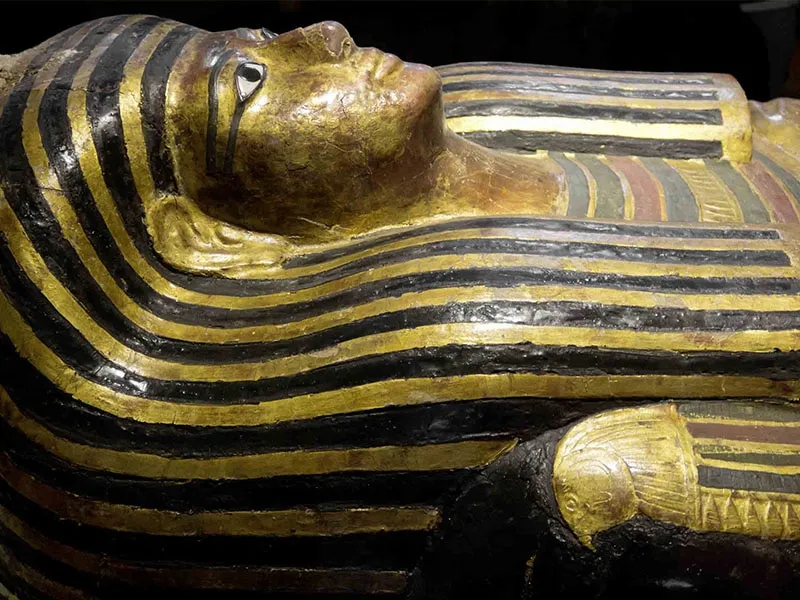
I hate to be the one who has to inform you of this, in case you've never heard, but...we used to eat mummies.
Have you ever heard of Bitumen?
Bitumen is an immensely viscous constituent of petroleum. In American English, it's more commonly referred to as asphalt. You know, the stuff they make roads out of. In fact, about 70% of annual bitumen production is destined for road construction. But, in the 12th century, when supplies of imported bitumen rant short, mummia was misinterpreted as mummy and the words meaning expanded to "a black resinous exudate scraped out from embalmed Egyptian mummies". Mummia, for clarification, is simply a term used to refer to several different preparations in the history of medicine. But it wasn't just a weird etymological goofup, it actually does have something to do with mummies. See, despite bitumen having many uses in the ancient world such as glue, mortar and waterproofing, the ancient Egyptians specifically began to use it for embalming practices during the Twelth Dynasty.
As a result, during the Crusades, European soldiers learned firsthand of the drug, mummia, and the demand increased tenfold because, they thought, it had great healing powers in cases of fracture and rupture. But because the supply of natural bitumen from Persia and the Dead Sea was limited, the search for a nedw source turned to the tombs of Egypt. When the ancient tombs of Egypt could not meet the European demand for the drug, however, a commerce developed in the manufacture and sale of fraudulent mummies. A lot of this stemmed simply from the basic misinterpretation of "mummia" as a whole, though. They substituted, in the definition, the blackened flesh of an entire mummy for the hardened bituminous materials from the interior cavities of the cadavers. In essence, it all came about simply because of a catastrophic misinterpretation on the part of European scholars who mistakenly conflated the two after the mistranslation of the Persian word "mumiya", leading everyone to believe that mummies possessed restorative powers.
In fact, today, the whole practice is considered "medicinal cannibalism", which is perhaps one of the funniest word combinations of all time.
Listen, there's a lot of information, specifically regarding the fake mummies, the misunderstanding of the etymology and much more on this subject, so personally, to save us both some time, I would defer you to the Wiki page for this whole ordeal, but the fact remains...we ate mummies as a healthcare alternative. In fact, for about 500 years, both the rich and the poor alike consumed mummia in various forms - with the demand for mummies leading to bodies being sourced by grave robbersm causing the supply of genuine mummies to then ran low - leading to a counterfeit market where the bodies of recently deceased individuals (not mummies at all, just guys like your neighbor, Dave) such as executed criminals, were dried out and then sold as authentic mummies.
And perhaps what's even worse is this isn't even the first time this kind of thing has happened. The Romans, for example, believed that the blood of a fallen gladiator could cure epilepsy. This is what's commonly known as "Corpse Medicine". And I can't believe I even have to say this but when something that's already morally questionable happens enough to warrant coining a new term for it, perhaps it's been done too many times.
In fact, in both a book by Louise Noble, a lecturer of English at the University of New England in Australia, titled "Medicinal Cannibalism in Early Modern English Literature and Culture" as well as Richard Sugg's "Mummies, Cannibals and Vampires: The History of Corpse Medicine from the Renaissance to the Victorians", it's gone into much greater detail about corpse consumption, which, now that I've said that out loud, is a fantastic metal band name. Not only do we learn that mummies were crumbled into a tincture to help with internal bleeding, but we also learn of the very ironic usage of skulls being crushed into a powdered form to help cure head ailments. Thomas Willis, 17th century pioneer of brain science, in fact, brewed a drink for apoplexy, which put powdered human skull and chocolate together. That's right. Skull chocolate milk.
In a piece from the Smithsonian Magazine (from which I've admittedly cribbed some information) on the subject, they state:
As science strode forward, however, cannibal remedies died out. The practice dwindled in the 18th century, around the time Europeans began regularly using forks for eating and soap for bathing. But Sugg found some late examples of corpse medicine: In 1847, an Englishman was advised to mix the skull of a young woman with treacle (molasses) and feed it to his daughter to cure her epilepsy. (He obtained the compound and administered it, as Sugg writes, but “allegedly without effect.”) A belief that a magical candle made from human fat, called a “thieves candle,” could stupefy and paralyze a person lasted into the 1880s. Mummy was sold as medicine in a German medical catalog at the beginning of the 20th century. And in 1908, a last known attempt was made in Germany to swallow blood at the scaffold.
This doesn't cover just dead people, by the way. According to a pseudo microfiche page from the Library of Congress blog back in April of 2022, they speak of something known as a Whale Hotel.
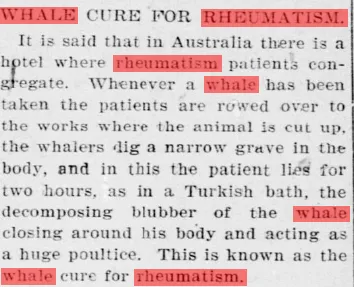
On page 10 of The Pacific, a commercial advertiser for Honolulu, Hawaii, dated April 12th 1899, there is a report on a hotel in Australia where one could go to find help with their rheumatoid arthritis. This treatment, however, was a little...unorthodox. See, whenever a nearby whale would die, patients would then be rowed to the whale, where the whale would be cut up and a narrow cavity would be made in its body. The patient would then enter the carcass and lay down for around two hours. This process, allegedly, relieved soreness and inflammation, thus helping ease the pain from the aforementioned disease. It's worth noting, however, that the treatment was reported to have been discovered by a drunken man, staggering along the beach near the whaling station of Twofold Bay, and who, upon seeing a dead whale cut open, took a header into the decomposing blubber. Considering how Australians love to just lie about things for the fun of it, I'd take this one with a big grain of salt.
Fun Fact: Traditional animal medicine is known as Zootherapy. One example of global traditional medicine systems incorporating animal parts for perceived healing properties are in China, where they use ingredients from over 1500 species, including bear bile, tiger bones and rhino horns; India, likewise, uses fermented mongoose or jackal meat for rheumatoid arthritis, and South America and Africa grind up tarantula fangs to treat, ironically, tooth aches and also asthma. And, to be fair, it isn't like we don't practice corpse medicine now. We just call it being an organ donor. We've sanitized the name, and the process is far more medical and socially acceptable. But the concept is still, essentially, the same. Utilizing the dead to heal the living.
Being an organ donor is noble. That's a sacrifice you're making to ensure the longevity of another person. And, often, you aren't murdered for your organs. The same can't be said for the folks who encountered Burke and Hare.
In the 1800s, Edinburgh, Scotland, was a leading European center for anatomical study, in a time when the demand for cadavers led to a shortfall in legal supply. Scottish law required that corpses used for medical research should only come from people who had either died in prison, committed suicide or, perhaps darkest of all, were orphans. This is where the Resurrection Men came in.
Ressurection Men were 18th and 19th-century body snatchers in Britain who secretly exhumed fresh corpses from graveyards to sell to anatomy schools for dissection. The problem was that the measures that had been taken to ensure graves weren't disturbed - such as mortsafes or mortcages, which were a construction designed solely to protect graves from disturbance - only further exacerbated the shortage they were already dealing with. The nice thing about capitalism though is that whenever there's an obstacle, the market rises to meet alternatives for the demand, and that's exactly what William Burke and William Hare did.
When a lodger in Hare's house died, he turned to Burke for advice, and they decided to sell the body to one Robert Knox - a Scottish anatomist and ehtnologist - for the generous lump sum of the 2025 equivelant of $705 dollars. Then, a little over two months later, when Hare was concerned a lodger with a fever would deter others from staying in the house, he and Burke murdered her as well, also selling her body to Knox. The men continued with this murder spree over the next ten months, and were only eventually stopped because their actions were uncovered after other lodgers discovered their final victim and contacted the police. I'm curious how lodgers discovered her. Did they just happen to leave her corpse somewhere one could easily stumble over her? Men really need to learn to clean up after themselves.
Needless to say, the Willy boys quickly turned on one another, with Hare being granted immunity from prosecution if he turned kings evidence, simply because although the police suspected them of other murders, there was no evidence on which they could take action with. Hare, perhaps unsurprisingly given what he was facing, did exactly that, providing details not only on the last victim but also confessing to all sixteen murders they committed, causing Burke to be found guilty and sentenced to death. He was subsequently hanged, and his corpse, perhaps in the most fittingly ironic twist of fate, was dissected and his skeleton displayed publicly at the Anatomical Museum of Edinburgh Medical School where it still remains to this day.
But the thing is, the murders did raise public awareness of the need for bodies for medical research and eventually contributed to the passing of the Anatomy Act 1832 just a few years after this entire ordeal. This was an act of Parliament of the United Kingdom that gave free license to doctors, teachers of anatomy and bona fide medical students to dissect donated bodies, and was enacted solely due to public revulsion at the illegal corpse trade, a trade that, quite frankly, the term "illegal" preceding it seems rather superfluous.
But you know what? And this is going to sound weird, but at least Resurrection Men (a great band name, now that I think about it) were taking corpses, and at least people were just snorting mummy. At least they weren't eating literal fetuses.
Cause, yeah. We were doing that too.
And, as late as 2012, of all times.
In 2017, Megumi Sasaki, a Japanese filmmaker and writer, released her third feature, a documentary titled "Whale of a Tale" about the Taiji dolphin drive hunt. It is a direct response to a 2009 documentary titled "The Cove", which discusses Japanese whalers killing Dolphins for food, a 400 year old practice, something that really only became a problem when well to do white people gave the film an Academy Award, offended on the behalf of a culture that had been doing this forever. And, for the record, I’m not saying I’m in favor of merciless dolphin murder, or fetus consumption for that matter, but the West’s belief that it has the right to police the world with its moral values is something that should be questioned.
The reason I bring this up is because the same can be said for certain medical practices in other cultures.
In the mid 1990s, Hong Kong journalists exposed an underground market in human fetuses, in both Mainland China as well as Hong Kong, where traders connected to hospitals sold aborted fetuses for consumption, charging up to $300 a piece and promising, along with it, all sorts of medical benefits, from rejuvination to a cure for asthma. Then, in 2011/2012, more than 17000 capsule pills were seized by South Korean custom officials from ethnic Koreans living in China, who had tried to bring them into the country to consume and distribute them to others. And what was in these capsules? Well, powdered flesh of human fetuses and stillborns, of course, touted for "increasing vitality and sex drive".
However, some experts would later go on to suggest that these may have actually been made of human placenta, as placentophagy is in fact a legal and relatively widespread practice in China. Either way, I'm not condoning eating babies (I can't believe that's a sentence I even have to type but considering what the internet takes at face value these days you can't be too careful) but I also don't think it's fair of us to police another cultures medicinal beliefs. Then again...
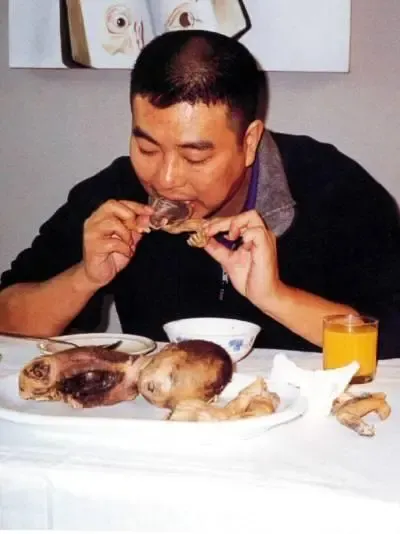
...In 2000, Chinese performance artist, Zhu Yu - possibly inspired by the reports of this custom - cooked and ate what he claimed to be a human fetus in a controversial piece of conceptual art. His performance, appropriately titled "Eating People" took place at a Shanghai arts festival, and when photos of it began to circulate on the internet the following year, both the FBI and the Scotland Yard started investigations into the matter. The thing is, nobody still knows to this day for certain what it was he ate. It was called conceptual shock art, a performance piece, mostly, as Zhu put it, to call into question the moral ambiguity that befalls such an act, noting that while it's immoral, it's not actually illegal, and that no religion technically forbids cannibalism. But Zhu himself claims he cooked and ate an actual six month old aborted fetus stolen from a medical school. Others, of course, question this, stating it has to be a prop, possibly constructed by placing a dolls head on a duck carcass.
The fact he says he stole it from a medical school is an interesting admission of a crime, if his claim is to be believed. There's also the incident of the director, Fruit Chan, who was repeatedly served an "exceptional soup" by his doctor, finding out only later that it was supposedly made of fetus. This would later be covered in his movie, "Dumplings", which features this custom heavily, along with the films screenwriter Lilian Lee, who believed they also ate such a soup.
This is interesting because this isn't even some back alley salesman now, this is just an honest to god medical facility claiming to feed its patient fetus soup, which, let's be honest, is another great band name. Either way, it's an interesting, albeit upsetting, custom, even if it's from a culture that might normalize such a thing. Hopefully the act of cannibalism for health benefits (or, in general, cause that makes me sound like I'm pro-cannibalism, and I'm not really hoping to perpetuate that belief) and corpse medicine as a whole has been mostly relegated to a thing of the past and we, as a society overall, can finally move on to bigger and better things.
Then again, in Bern, Switzerland, there's a painted stone fountain featuring the Kindlifresserbrunnen - a seated ogre devouring a naked child, while at his side is a bag containing more children - which translates literally to "Fountain of the Eater of Little Children", so maybe we're just weird as hell.
I am not an organ donar.
It isn't something I'm even against, it's just not something I ever really took the time to really think about, and besides, my fiance, not me, is the one who drives. But the interesting thing about organ donation is it's a choice you make before you die. This means that, at some point, maybe even as early as into your late twenties, you could possibly be thinking about how your body will be used after you expire, perhaps to benefit others, and while it's a noble sacrifice you're making, it's certainly morbid. But, maybe not as morbid as the process of mellification. The Mellified Man, also known as a human mummy confection, was a legendary medicinal substance created by steeping a human cadaver in honey. The conction is, reportedly, what occurs when some elderly people, nearing the end of their lives, opt to submit themselves to a process of mummification in honey to create a healing confection.
See, unlike simply donating ones organs or even being used after death without your consent, this involved direct self sacrifice. The process would ideally start before death, with the donar no longer eating any food other than honey, even going so far as to bathe themselves in the sweet sticky substance. Then, their feces, as well as their sweat, would also consist of honey. When this diet eventually, understandably so, proved fatal, their body would be placed in a stone coffin, and you're not gonna believe what they filled the coffin with. That's right. More honey.
Then, after a century or so, these contents would have turned into a sort of confection, reputedly capable of healing broken limbs and other ailments. It would go on to be sold in street markets as a rather hard to find item with a heft price tag attached. And, while there are instances of it supposedly happening throughout history here and there, most notably to the body of, of all people, Alexander the Great, it is still considered somewhat of a myth. Though, if we're being honest, some company is really missing out on not marketing their honey in the shape of a sacophagus.
In the 1999 horror action film "The Mummy" starring Brendan Fraser and Rachel Weisz, a treasure hunter and a librarian arrive in Hamunaptra, the City of the Dead, in Egypt, where they accidentally awaken Imhotep, a cursed high priest with supernatural powers. To regain his human form, he must hunt and kill the men who stole five canopic jars, consuming the men in the process and strengthening his powers. While it's really just a means to have some of the cast meet rather gruesome, and somewhat deserved, ends, it's interesting to me that this seems to be a direct role reversal of people consuming mummies for the benefit of their own health.
I have to say, while there's some things about modern medicine that may be disgusting, at least nobody is trying to feed me a mummy.
Certain cough syrups can be hard enough to swallow.