The Lost Art Of Dinoforgery
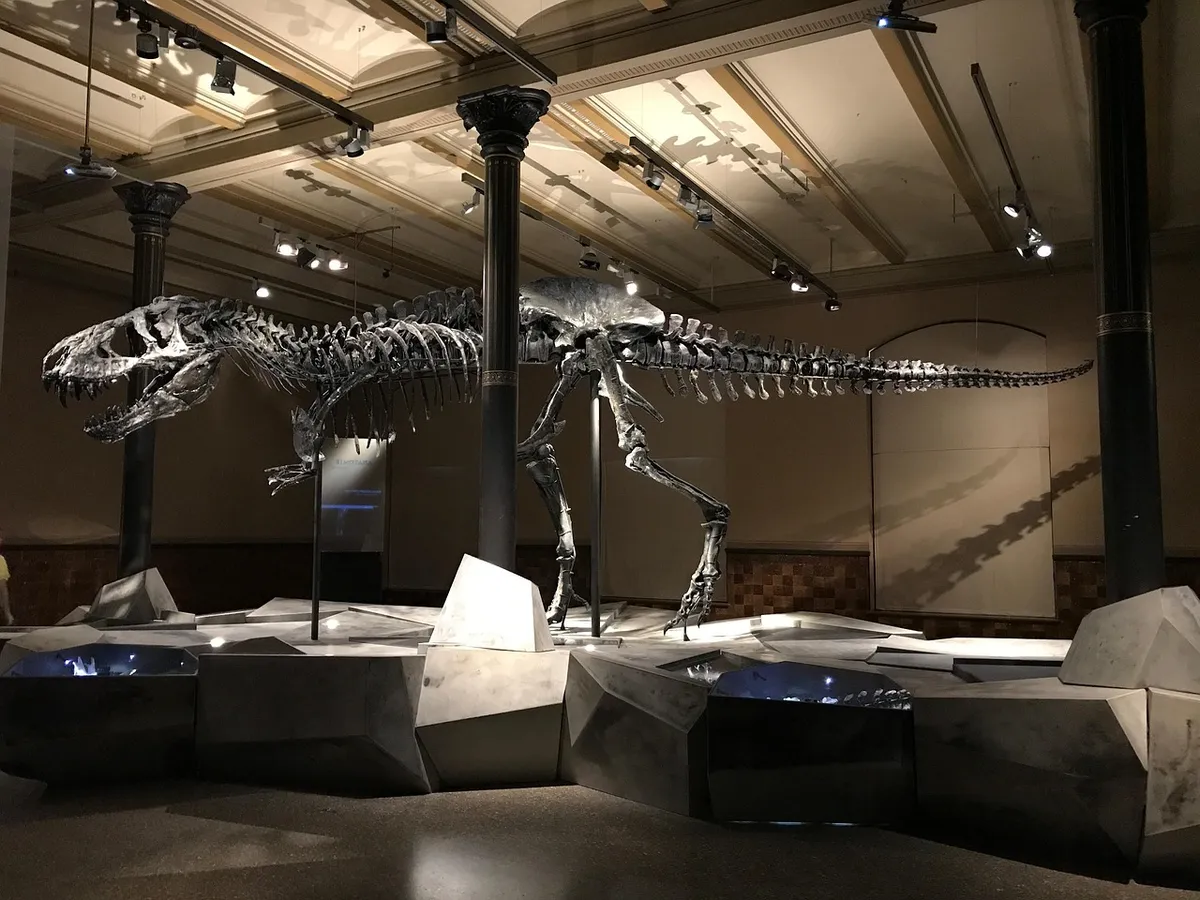
You would think that having access to all the knowledge in the world, at your fingertips, would only increase mankinds IQ, but if anything, the complete opposite has happened.
Gone are the days of crackpot conspiracy theorists and tinfoil hat fashionistas that nobody took seriously, one to a neighborhood, and now, people who not only believe but spread misinformation can gain a following and use their newfound illgotten fame to further push incorrect agendas to people in positions of power, who are also dumb enough to believe them, and the cycle continues, seemingly forever. I remember being a little girl and believing in things that nobody should believed in, but that's because I was a child with a not fully developed frontal lobe. Even coming from such a well educated household as I did, I still didn't believe things that were very obviously untrue. I miss those days, though. The days when conspiracies were more along the lines of
"there's a giant aquatic creature of unknown origins at the bottom of a lake"
and not
"the earth isn't round".
But the funny thing is, sometimes beliefs are steeped in a seed of truth.
Take the folks who don't believe in evolution, for example. Some people in religions, particularly the Christian and Jewish literalist groups, do not believe dinosaurs existed. This denial stems from a literal interpretation of creation stories that directly conflict with the age of the earth and fossils, leading some to believe that fossils are nothing more than a deception planted to test faith amongst their ranks and that dinosaurs were never actually real. But this belief is so incorrect. There's so much evidence to the contrary that, while I'm not one to belittle someones religion, the idea that dinosaurs didn't exist is easily disproven. And yet, within that belief, exists a kernal of reality, because, well...
...sometimes dinosaurs didn't exist.
In December of 2012, NPR released an episode of their audio series "All Things Considered", which is quite ironic given the topic. In it, they discuss the very real fact that the Brontosaurus, a dinosaur that I grew up knowing, loving and was made famous in multiple films such as "Jurassic Park" and "The Land Before Time" just...wasn't actually real. They state that the fraud dates back to 130 years prior, during a period of early US paleontology known as the Bone Wars - which sounds way cooler than it actually is - a bitter competition between two paleontologists, Yale's OC Marsh and Edward Drinker Cope of Philadelphia. Simply put, their hated eachother, and that, combined with their ravenous scientific ambitions, led to the men attempting to outdo one another by simply pushing dinosaur names into publication all willy-nilly. And if you've never done anything all willy-nilly, I highly recommend it.
In 1877, when this was all occurring, Marsh discovered a partial skeleton of a long necked, long tailed, leaf eating dinosaur that he dubbed the Apatosaurus. It was missing a skull, but was otherwise considered complete. Then, in 1883, he published a reconstruction of said Apatosaurus, where he used the head of another dinosaurs, thought now to be a Camarasaurus, to complete the skeleton. Two years later, his fossil collectors that were working out west sent him a second skeleton that he believed belonged to an entirely different dinosaur which he named the Brontosaurus. But, the thing is, it wasn't a different dinosaur. It was just a more complete Apatosaurus. In his drive to constantly one up his rival, he simply mistook it for something entirely new and published his findings.
The really hilarious thing, however, is that this mistake was discovered by scientists all the way back in 1903, and yet the dinosaur was never truly questioned. For god sakes, the Carnegie Museum, located in Pittsburgh, even put the wrong head on their own Apataosaurus skeleton in 1932, where it stayed for almost 50 years. It actually wouldn't be until the 1970s when two Carnegie researchers finally took a closer look at it and determined that a skull found in a quarry in Utah in 1910 was the actual Apatosaurus skull, and in 1979 the whole thing would finally be put to rest when the correct head was finally placed atop the museums skeleton, like some kind of goofy prehistoric Headless Horseman.
The irony of all of this? The Apatosaurus's name means "deceptive lizard", which is...yeah. That tracks.
Interestingly enough, this entire tale is retold in a somewhat fictionalized manner in Michael Crichton's 2017 book "Dragon Teeth". Initially written in 1974 but not published until 2017 - impressive for a man who'd been dead for 9 years at that point - the book follows the fictional protagonist William Johnson, a Yale student who works during the summer alternately for the two paleontologists Marsh and Cope during The Bone Wars. I mention this because this won't be the only time Chrichton is brought up.
And if this was a one off instance, that would be a funny footnote in our archeological history, but it happened repeatedly. Fossil forgery is such a common thing that, well, it has a name. For example, the Archaeoraptor is another famous example of a fossil forgery that was a composite of, yet again, real fossils from different animals, presenting itself as a missing link betweens birds and dinosaurs. The thing is, though, these are instances of misidentification, not out and out attempts to pull the wool over our eyes. Marsh wasn't trying to trick people into believing this dinosaur existed, he genuinely thought that was what he'd discovered was. The same can be said for the Archaeoraptor, really, because despite being published in respected magazines like National Geographic in 1999, it's hard to make the claim that those involved with its creation - it essentially was constructed from rearranged pieces of real fossils from different species - were doing this deliberately. According to said National Geographic report, actually, this whole story began in July 1997, in China, where farmers routinely dug in pits with picks and sold fossils to dealers for a few dollars.
One farmer in particular found a rare fossil of a toothed bird, complete with feather impressions, which broke into pieces during collection. Nearby, in the same pit - and this is where things get mucked up - he found pieces including a feathered tail and legs and then cemented several of these pieces together in a manner that he believed was correct. He knew it would make a more complete looking and, thusly, more expensive, fossil to prospective dealers. It was then sold in June of 98 to an anonymous dealer where it was smuggled to the US. The problem here is that this one wasn't done by an actual paleontologist, but instead a mistake purported by multiple people, none of whom had any scientific knowledge, because once it hit the states, it showed up at a gem show in Tucson, Arizona, where the Dinosaur Museum, in Blanding, Utah - a more appropriate name for a city in Utah than I could ever come up with on purpose - purchased it in February of 99. This museum was run by Stephen Czerkas and his wife, Sylvia. But see, again, much like the farmer who found it and created it, neither of them held any university degrees. Stephen was merely a dinosaur enthusiast and artist.
Perhaps, the irony of this all, is that this scandal is sometimes used by creationists like Kirk Cameron to cast doubt on the hypothesis of evolution, and that birds evolved from dinosaurs.
Crichton, and I say this with the upmost respect to his estate so that his legal team doesn't sue me into the ground, was the literary example of OC Marsh, and nothing hammers home his inconsistencies and inaccuracies in his work surrounding dinosaurs moreso than the fact that the wiki based on his most famous work, Jurassic Park, has an entire section dedicated to said inaccuracies and inconsistencies. Let's start with the fact that, despite it's title being "Jurassic", the majority of dinosaurs in the franchise, including the T. Rex, Stegosaurus, Triceratops, as well as lesser known species such as Maiasaura and Dilophosaurus, actually lived in the Cretaceous period.
But perhaps the most damning is how the most popular Dinosaur in said film, the Velociraptor, was portrayed as a terrifyingly fast and vicious predator when in actuality this portrayal was inaccurate, both in terms of size considering the Velociraptor in question actually stood barely half a metre high, and its lack of feathers, technically called "quill knobs", which proved that Velociraptor was feathered, were overlooked until 2007 when they were discovered. In regards to its size and large sickle-shaped talons on each foot, the dinosaur presented as a Velociraptor in the film is technically more like Velociraptor's dromaeosaurid cousin, Deinonychus. But Crichton - who did use the concept of DNA altering and cloning to mask inaccuracies, getting out ahead of people who might spot them - maybe can't be blamed entirely, considering that this portrayal may have come about because of the mislabelling of Deinonychus as a subspecies of Velociraptor in the 1988 American book, "Predatory Dinosaurs of the World", whose author, Gregory Paul, is credited as an inspiration by Crichton.
Seems lots of people, ironically enough even those who seemingly work in the field, are actually wildly misinformed about dinosaurs. Guess it's hard to be accurate about the taxonomy of creatures that went extinct millions of years ago.
Go figure.
There's a short arc in Bill Watterson's famous comic strip "Calvin & Hobbes" where Calvin, who is obsessed with dinosaurs, goes on an expedition to unearth bones in his neighborhoods backyard. What he uncovers is actually just litter, garbage, tossed away bottles and forks and cans, but he creates a dinosaur out of them and thinks he can sell it to the local history museum for a pretty penny. Calvin, and it's important to keep this in mind, is a six year old boy. But more importantly, he genuinely believes that what he discovered was, in fact, an actual dinosaur. He only accepts the reality of the situation when his mother informs him that it's not a dinosaur, and is, instead, just some trash.
There's plenty of intentionally fake dinosaurs out there. Whether it's fictional ones made up for film, or sites like the Speculative Dinosaur Project, which was an online alternate history project that ran for several years in the 2000s about a paralell earth where dinosaurs never became extinct, these are all made up for fun. Not for genuine misinformation. Nobody involved in the creation of the fictional Indominus Rex for the Jurassic World films was doing so with any kind of malice, hoping to pull a fast one on people and get them to believe that such a creature actually existed. The Speculative Project, likewise, is admittedly a work of fiction. And even Marsh, and the Stephen Czerkas, truly believed these discoveries to be real. Again, there was no intention for a misdirect.
But what about when there is?
Let's talk about the Tridentinosaurus antiquus. A small lizard-like reptile that lived during the Permian period (299-252 million years ago), where the Alps are today, and discovered in 1931, the specimen was prized for what scientists thought were carbonised traces of the skin visible on the surface of the rock, an exceedingly rare type of preservation. It was found in tuffaceous sandstone layers of the Regnana Formation ('Stramaiolo' (Redebus) locality) in Trentino-Alto Adige, Italy. The only parts of the skeleton that are preserved, as it turns out, are the long bones of the hind limbs and it's supposedly soft tissue body outline.
But therein lies the problem. See, in 2024, Valentina Rossi, writing for Scientific American, finally got to get up close and personal with it, discovering ultimately that the skin is actually fake, and that what was thought to be well-preserved carbonised skin was little more than just a carved lizard-shaped body impression covered in black paint. This, perhaps, might be the laziest example of fossil forgery we've seen. I'll let you read about their findings here, because it's quite a piece, honestly. It's unknown when it was created or who was involved, and while the rest of it is genuine, it's still a shame that the forged skin (a horrifying two word sentence, if we're being honest) taints what would otherwise be a fantastic historical piece.
And, for what it's worth, in 2015, a morphological study of both the Apatosaurus and the Brontosaurus families, to which both genera belonged, showed that the physical differences were sufficient enough to separate them into two distinct genera, leading to the reinstatement of the Brontosaurus. This is kind of like when an athlete who breaks a world record gets accused of having done so with the help of steroids, and then gets their name cleared after the truth comes out. Except, you know...the Brontosaurus thing actually happened. If anything, it's more akin to the whole "Is Pluto a planet" debate.
I guess, ultimately, I'm of two minds.
The first is that it's unfortunate that peoples greed hampers a crucial aspect of identifying historical remains, sometimes even bringing into question, as a result, the validity of it all to begin with. The second, and this may sound ridiculous but I'm going to stand by it, is that if you're going to perform fossil forgery, at least do it well. You're already committing a possible crime, why not do the best job you can do while you're at it. That's the problem with people these days, everyone wants to half ass everything, nobody puts in 100% effort anymore. I know it's an absurd thing to be annoyed by, but I guess my reasoning is just that if you're willing to go to those lengths from a monetary gain, why not go the extra mile to ensure it's as believable as possible? Why not try to be the best forger you can be? I swear, sometimes it feels like you people don't even want to commit crimes.
Take Johann Beringer's "Lying Stones", for instance.
In 1725, Johann Beringer, the dean of the University of Würzburg’s Faculty of Medicine, developed an interest in attaining strange rocks and specimens from beneath the earth which he dubbed “formed stones.” Considering this was the early 1700s, scholars of the time knew very little about the ways that fossils were created. However, upon learning that Beringer had hired three teenagers to search for such artifacts for him, University librarian Johann Georg von Eckhart and professor J. Ignatz Roderich saw their opening to humiliate Beringer, and thus they conspired with a local noble to carve impressions of fishes, frogs, insects, crabs, plants and even the sun and the stars, into pieces of limestone and plant them for Beringer’s teens to discover. Thus, over a period of six months, his assistants dug up and sold him an estimated 2,000 such carvings. The doctor was tricked, hook line and sinker, and even published a book about the findings one year later, with 21 engraved plates. When the deception was eventually revealed, an incensed Beringer sued von Eckhart and Roderick. Sad to say, there's not a winner in this story, as the university cut ties with the perpetrators, while Beringer himself never published on fossils again.
But my goodness, how absolutely dumb do you have to be to think that the sun and the stars would be engraved on a rock? Guy kinda got what was coming to him. That's the thing though, a lot of these people aren't actually paleontologists, they range from folks with a somewhat passing interest and folks with a greed that overwhelms the sincerity of said interest.
If Beringer had just done even a little bit of his own research, had someone at the school look at them (there's photos available, and let me tell you, it's plain as day that they're fake), he would've saved himself a whole lot of trouble. And, likewise, even the examples such as the Archaeoraptor hold a sand of validity, because yes, dinosaurs, as we discussed, were in fact feathered and hold an evolutionary throughline to birds, something - and I feel this is important which is why I'm going to reiterate it here - that Kirk Cameron doesn't believe. But these were just fake as fake could be, looking like something you'd see on a dinosaur themed ride at an amusement park as queue dressing. And while I recognize this wasn't his forte, still, Beringer was the Dean of an entire school of medicine, so, presumably, the man had to be smart, right? One would think so, anyway.
Again, the lowest amount of effort given to such a rich interest. And yes, Beringer, as with others, believed what he'd been given to be genuine, there was no malice to his actions in regards to attempting to fleece the scientific community, but even so. I used to hate when teachers used the phrase "show your work" but man, now I get it.
The world the dinosaurs knew is a world that is, in turn, completely unknowable to us. There's absolutely no documentation of it, in a traditional media sense anyhow, outside of things like fossils, so a lot of stuff is speculative at best, and informed on by what was left behind for certain.
I think this is why people think they can get away with forging fossils. They think, well, it was so long ago in the past, and dinosaurs are already so otherworldly, that this thing I'm creating surely would fit right in with them. But I think it also goes deeper than that, psychologically. I think it's humans innate need for controlling every moment of history. We rewrite history to fit our needs, we create throughlines where there were none so that everything follows a neat and tidy order to its inevitable conclusion where we look all knowing. But you can't pull a fast on on science. Science is the one thing that will break past the lies, and find the truth hidden below.
As those forgers learned with the lizard skin, you can put lipstick on a pig but it's still a pig.
At the end of it all, I, for one, am happy to have witnessed the Brontosaurus reclaim his street cred, and once again find his place amongst the literal giants of his time. I didn't want to live in a world without a Brontosaurus. Things like dinosaurs make the world a more magical place to inhabit. And as I said at the start, I miss when conspiracy theories were fun, and very clearly probably fake but at least enjoyable to partake in, even with the accepted reality of its falsehood, such as the aforementioned Loch Ness Monster. We need things like that to make the world a more enjoyable place to live, a place where the unimaginable is still seemingly plausible. Far be it from me to say that people who don't believe in evolution are wrong, they're perfectly entitled to their opinions, but I will say that perhaps creationisms biggest detriment to society is just the fact that it's making the world less magical and interesting by denying our reality of incredible creatures.
We NEED dinosaurs.
Nobody NEEDS Kirk Cameron.